
Nano Insulation Board for Extreme Heat Protection

banner

Insulation and Refractory Materials

48.Microporous Composite Board (1)
48.Microporous Composite Board (2)
48.Microporous Composite Board (1)
48.Microporous Composite Board (2)
48.Microporous Composite Board (1)
48.Microporous Composite Board (2)
48.Microporous Composite Board (1)
48.Microporous Composite Board (2)
Nano Insulation Board

Laurel Nano Insulation Board is a high-performance thermal insulation material developed for industrial equipment where reducing heat loss and insulation thickness are both important. Its insulation structure incorporates nano-scale pores or particles to reduce heat transfer through the solid and gas phases, allowing high thermal resistance to be achieved in a relatively thin section.

Compared with conventional calcium silicate, ceramic fiber, or insulating refractory products, a Nano Insulation Board can provide significantly lower thermal conductivity at comparable temperatures. This makes it particularly useful as backup insulation in industrial furnaces, kilns, heat-treatment equipment, hot pipelines, and other high-temperature applications where installation space is limited.

Laurel supplies nano-based insulation boards in different thicknesses and configurations. The material can be selected according to operating temperature, required insulation thickness, mechanical loading, installation space, and the thermal performance required by the equipment.
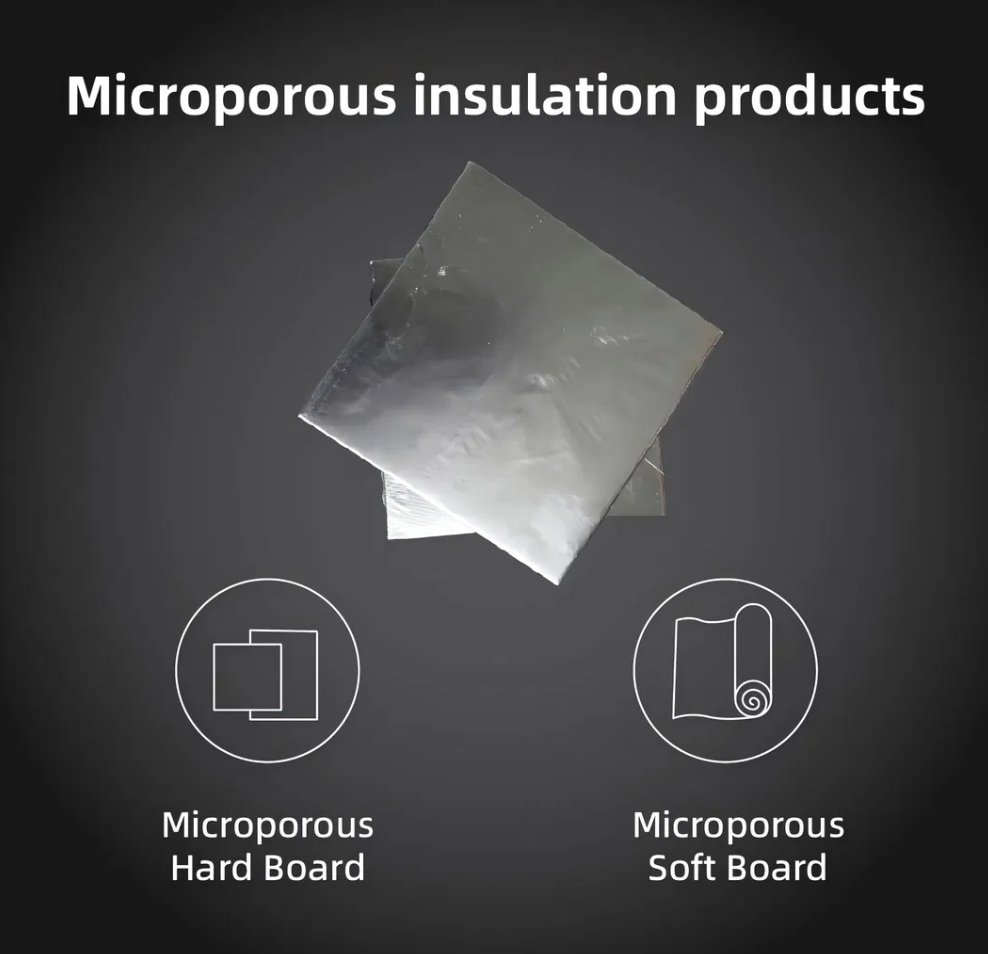
Product Details


Nano Insulation Board is a rigid or semi-rigid high-temperature insulation panel that uses a nano-structured insulating medium to reduce heat transfer.

Heat is transferred through insulation mainly by solid conduction, gas conduction, convection, and radiation. The nano-porous structure limits gas movement and reduces the effective path available for heat transfer. When combined with suitable inorganic components and reinforcement, this structure can provide very low thermal conductivity without requiring a very thick insulation layer.

This characteristic is especially valuable when the available space between the hot face and the furnace shell is restricted.

For industrial applications, Nano Insulation Board is commonly used as a backup insulation layer behind refractory bricks, castables, ceramic fiber modules, or other hot-face materials rather than being exposed directly to severe mechanical abrasion.

Nano Insulation Board Material Structure

The insulation performance of a nano-based board is strongly related to its pore structure.

Conventional insulation materials often contain relatively large pores through which gas can transfer heat. Nano insulation materials use much finer pore structures to restrict this heat-transfer mechanism.

A typical nano insulation board may contain:

  • Nano-structured silica-based insulating material

  • Inorganic reinforcing components

  • High-temperature binders

  • Fiber reinforcement where required

  • Opacifying components to reduce radiation heat transfer

The exact formulation varies according to the required temperature range and mechanical properties.

The objective is to create a stable microporous or nano-porous structure that maintains low thermal conductivity while providing sufficient dimensional stability for industrial installation.


Table parameters

ItemMicroporous hard board
Density (kg/m3)280-300
Maximum operating temperature(ºC)900
Compressive strength(Mpa)≥0.30
Linear Change 900ºCx24h(%)≤ 2


Thermal Conductivity(w/m.k)
0.022  (Mean 100ºC)
0.023  (Mean 200ºC)
0.025  (Mean 300ºC)
0.027  (Mean 400ºC)
0.031  (Mean 500ºC)
Covering MaterialsAluminum Foil/ PE Foil


Features

Nano Insulation Board for Industrial Furnaces

Industrial furnaces are one of the most important applications for nano insulation.

A furnace loses heat through its walls, roof, doors, joints, and other thermal paths. Improving insulation reduces the amount of energy required to maintain the desired internal temperature.

Nano insulation boards can be installed as a backup layer behind the hot-face refractory.

A typical furnace wall may use:

Hot Face Refractory → Backup Insulation → Nano Insulation Board → Furnace Shell

The nano layer can reduce heat transfer toward the steel shell while keeping the total wall thickness within the available design space.

This approach is particularly useful when an existing furnace is being upgraded but the external dimensions cannot be significantly increased.

Nano Insulation Board for Kilns

In ceramic and refractory kilns, insulation thickness has a direct influence on furnace dimensions and thermal mass.

Nano insulation can be considered for:

  • Ceramic kilns

  • Tunnel kilns

  • Shuttle kilns

  • Heat-treatment kilns

  • Sintering kilns

  • Laboratory furnaces

  • Electric furnaces

For new kiln construction, the board can be incorporated into the insulation design from the beginning.

For existing equipment, it can be evaluated as part of a thermal upgrade when the existing insulation thickness is insufficient or available space is limited.

Nano Microporous Insulation Board

Nano Microporous Insulation Board combines nano-scale insulation characteristics with a microporous structure to achieve low thermal conductivity and compact insulation thickness.

The terminology used by manufacturers can vary. Some products marketed as nano insulation are themselves based on microporous silica structures, while others use additional nano additives or engineered nano-scale components.


Inquiry Now

contact us

Your satisfaction is our top priority. Whether you have questions, need support, or want to share feedback, our dedicated team is ready to assist you every step of the way.

+86-15264257623

-2

info@laurelrefractory.com

+86-532-80829560