Eight Key Factors Affecting the Thermal Conductivity of Ceramic Fiber Boards
The thermal conductivity of ceramic fiber boards is a core indicator for evaluating their insulation performance. The lower the thermal conductivity, the stronger the material's ability to block heat, and the more significant the energy-saving effect. Because ceramic fiber boards have a porous structure composed of a solid fiber skeleton and numerous air pores, their heat transfer mechanisms include solid conduction, gas convection, and thermal radiation. Therefore, the actual measured value is usually called the "apparent thermal conductivity."
In industrial furnaces, pyrolysis furnaces, heat treatment furnaces, and kiln backing systems, the thermal conductivity of ceramic fiber boards is not a constant value but is comprehensively affected by the following eight key factors:
1. Operating Temperature – Radiation Heat Transfer Dominates at High Temperatures
The thermal conductivity of ceramic fiber boards increases with increasing temperature, which is determined by the change in the internal heat transfer mechanism of the material.
In the low-to-medium temperature range (<600℃), heat transfer is primarily conducted through solid-state conduction and pore gas conduction.
When the temperature rises above 800℃, radiative heat transfer between pore walls increases rapidly.
Above 1000℃, radiative heat transfer becomes the dominant factor.
Therefore, under high-temperature conditions, even if the density of the ceramic fiber board remains constant, its thermal conductivity will still increase significantly. This is a key reason why the insulation layer thickness must be increased in the design of high-temperature kilns.
2. Porosity and Pore Structure – The Fundamental Source of Insulation Performance
The porosity of ceramic fiber boards is typically over 80%. The thermal conductivity of air at room temperature is only about 0.025 W/(m·K), far lower than that of solid alumina fibers. Therefore, the large amount of enclosed air is the core source of the material's low thermal conductivity.
However, the pore structure is equally crucial:
Larger pore size → Enhanced convective heat transfer → Increased thermal conductivity
High proportion of interconnected pores → Increased heat flow channels → Decreased insulation
Closed pore structure → Restricted convection → Optimal insulation performance
Therefore, high-performance ceramic fiber boards rely not only on high porosity but also on a well-designed micropore distribution structure.
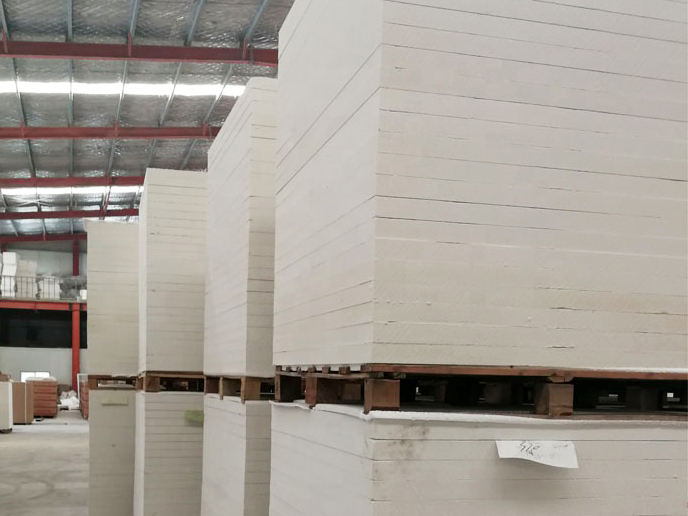
3. Ceramic Fiber Board Density – An “Optimal Density Range” Exists
The relationship between ceramic fiber board density and thermal conductivity is non-linear; lighter is not always better.
The general rules are as follows:
Low-density zone: Increased density → More fiber contact points → Suppressed gas convection → Decreased thermal conductivity
Optimal density zone: Achieves the lowest thermal conductivity
High-density zone: Increased solid conduction path → Increased thermal conductivity
Furthermore, the optimal ceramic fiber board density varies at different temperatures:
Low-temperature applications (≤600℃): Lower density is better
High-temperature applications (≥1000℃): Appropriately increasing density helps suppress radiative heat transfer
Therefore, when designing furnace lining systems, the density of ceramic fiber boards must be matched according to the operating temperature, rather than simply pursuing lightweighting.
4. Slag ball content – Affecting structural uniformity and heat transfer path
Slag balls are granular materials that are not fully fibrous during fiber production. Increased slag ball content has three effects:
Reduced effective fiber quantity
Disruption of uniform porous structure
Increased local solid heat conduction channels
The result is an increase in thermal conductivity, with the effect becoming more pronounced at higher temperatures. Simultaneously, slag balls also reduce material elasticity and thermal shock resistance; therefore, high-end ceramic fiber boards typically have strictly controlled slag ball content.
5. Fiber Diameter – Microstructure Determines Thermal Resistance
Under the same ceramic fiberboard density:
Fineer fibers → Smaller pores → Suppress air convection
Increased total fiber length → More tortuous solid conduction path → Reduced thermal conductivity
The optimal fiber diameter is typically controlled within the range of 2–4 micrometers. Excessively thick fibers increase thermal conductivity; excessively thin fibers may lead to increased high-temperature shrinkage. Therefore, both thermal stability and insulation performance must be considered.
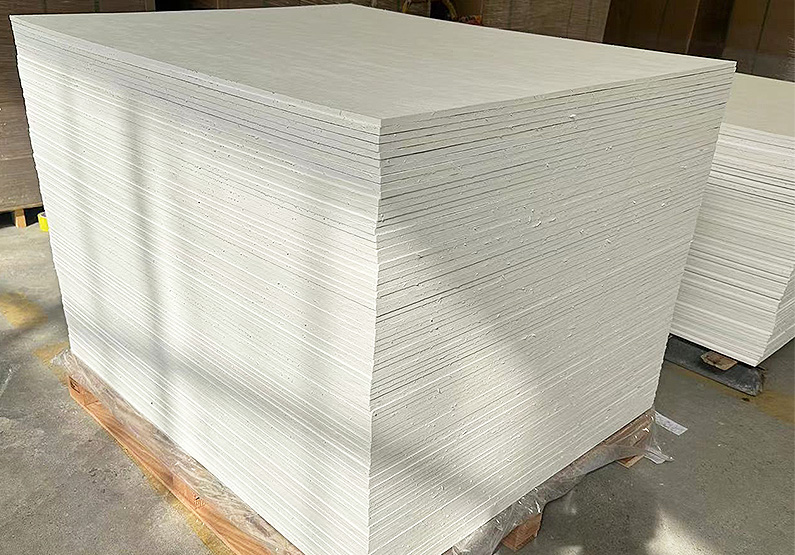
6. Moisture Content and Humidity – Potential Hidden Thermal Bridges
Water has a much higher thermal conductivity than air:
Water ≈ 0.522 W/(m·K)
Ice ≈ 2.32 W/(m·K)
Air ≈ 0.025 W/(m·K)
If the ceramic fiber board becomes damp, the air in the pores is replaced by water, significantly increasing the thermal conductivity, especially noticeable in low-temperature insulation projects. Therefore, while controlling the density of the ceramic fiberboard, moisture-proof design is also essential.
7. Operating Atmosphere – Significant Differences in Gas Thermal Conductivity
The thermal conductivity data tested in air may not be entirely applicable to furnaces with specific atmospheres.
For example:
Hydrogen has a higher thermal conductivity than air.
Gas heat transfer is almost nonexistent in a vacuum environment.
CO, CO₂, and other atmospheres have a moderate impact.
The smaller the molecular weight of the gas, the stronger its thermal conductivity. Therefore, in protective atmosphere furnaces or pyrolysis furnaces, the thermal conductivity data of ceramic fiber boards should be adjusted according to the atmosphere.
8. Fiber Alignment – Structural Design Affects Heat Flow Path
Ceramic fiber boards are anisotropic materials.
Heat flow perpendicular to the fiber direction → lower thermal conductivity
Heat flow parallel to the fiber direction → higher thermal conductivityLayered structures generally have better insulation performance than stacked structures. Under the same ceramic fiber board density, the thermal conductivity of a stacked structure may be 20%–30% higher.
Comprehensive Analysis
The thermal conductivity of ceramic fiberboard is not a single physical constant, but rather the result of the coupled effects of multiple factors, including temperature, ceramic fiberboard density, porosity, slag ball content, fiber diameter, humidity, atmosphere, and structural orientation.
In engineering design, the following should be emphasized:
Rationally selecting the ceramic fiberboard density
Controlling the slag ball content and fiber diameter
Adjusting the material grade according to temperature
Determining the laying method in conjunction with the furnace structure
Only when material parameters and operating conditions are matched can high efficiency, energy saving, and long-term stable operation be truly achieved.
Related Products
Inquiry Now
Please leave your e-mail and we will contact you as soon as possible
+86-15264257623 Jacky Liu
1003, Building 1,The Fortune Zone, No.17 Lian yungang Road,Qingdao,China
For more details, welcome to message us.
Copyright © 2025 Qingdao laurent new materials co.,ltd.All Rights Reserved.
 Powered by HiCheng
contact us
Your satisfaction is our top priority. Whether you have questions, need support, or want to share feedback, our dedicated team is ready to assist you every step of the way.