5 Types of Lightweight Insulating Bricks Commonly Used in Glass Melting Furnaces
Glass melting furnaces are one of the core pieces of equipment in the glass production process, operating at the highest temperatures and for the longest continuous periods. The furnace interior is constantly subjected to high-temperature radiation and thermal shock. To reduce heat loss from the furnace body, decrease fuel consumption, and extend furnace life, a multi-layer refractory system is typically used in the furnace lining. Lightweight Insulating Bricks play a crucial role in insulation and energy saving within this system. Compared to dense refractory bricks, these materials significantly reduce thermal conductivity through their internal porous structure, making them the preferred choice for the insulating layer of glass melting furnaces under conditions where they do not directly contact molten glass or flames.
Basic Characteristics of Lightweight Insulating Bricks
The core performance indicators of lightweight Insulating Bricks include bulk density, apparent porosity, thermal conductivity, service temperature, and mechanical strength. Their insulation mechanism primarily stems from the large number of closed or semi-closed pores within the brick body, which effectively block heat conduction. Based on the service temperature, they can be divided into low-temperature type (<900℃), medium-temperature type (900-1200℃), and high-temperature type (>1200℃); based on the raw material system, they can be divided into clay-based, silica-based, alumina-based, and mullite-based types. It should be noted that lightweight insulating bricks generally have low compressive strength and limited slag resistance and thermal shock resistance, so they are usually only used in the backing or insulating layer of glass melting furnaces and do not directly contact molten glass or high-temperature flames.
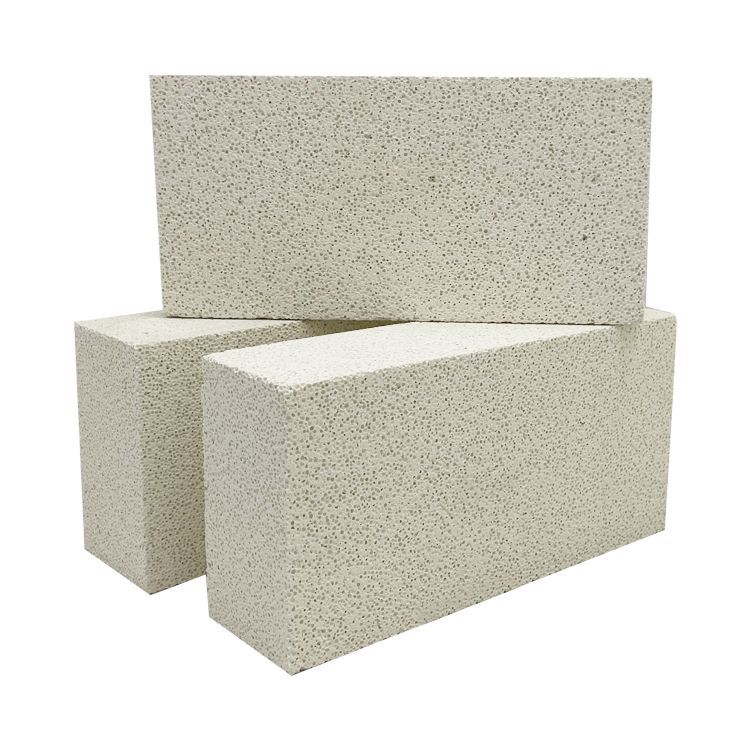
5 Types of Lightweight Insulating Bricks Commonly Used in Glass Melting Furnaces
1. Lightweight Clay Insulating Bricks
Lightweight clay insulating bricks use refractory clay as the main raw material, with an Al₂O₃ content generally ranging from 30% to 48%, and are manufactured using the burnout method or the foam method. Their bulk density can be controlled between 0.3 and 1.5 g/cm³, and they have good insulation performance. They are suitable for insulation parts below 1200-1400℃ that do not come into contact with molten materials and strong corrosive atmospheres, and are one of the most widely used and economical insulating materials in industrial furnaces.
2. Lightweight Silica Insulating Bricks
Lightweight silica insulating bricks use silica as the main raw material, with an SiO₂ content typically not less than 91%. These bricks have a bulk density of approximately 0.9–1.1 g/cm³, a thermal conductivity that is only half that of ordinary silica bricks, a load softening start temperature of up to 1600℃, and a long-term service temperature of 1500–1550℃. Their characteristic of not shrinking at high temperatures, or even slightly expanding, makes them very suitable for use as the insulating backing layer in the high-temperature zone of glass melting furnaces.
3. Lightweight Alumina Insulating Bricks
Lightweight alumina insulating bricks use electrofused corundum, sintered alumina, or industrial alumina as the main raw materials, and are usually produced using the foam method or the burn-out additive method. These materials have high refractoriness and good thermal shock resistance, with a typical service temperature of 1350–1500℃. High-purity alumina products can even be used at 1650–1800℃, and are often used as high-performance insulating layer materials in the high-temperature zones of glass melting furnaces.
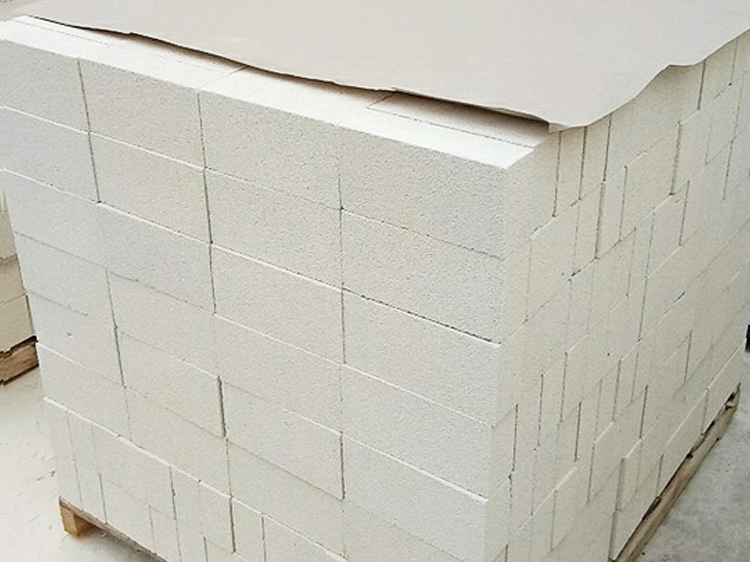
4. Lightweight Mullite Insulating Bricks
Lightweight mullite insulating bricks have mullite as the main crystalline phase, combining the advantages of high refractoriness, high mechanical strength, and low thermal conductivity. Compared with other lightweight bricks, they have better high-temperature structural stability, and some products can be in direct contact with flames, making them suitable for high-temperature inner linings or high-grade insulating layers in glass melting furnaces and other industrial kilns.
5. Diatomaceous Earth Insulating Bricks
Diatomaceous earth insulating bricks use natural diatomaceous earth as the raw material and have an extremely fine and uniform pore structure. Therefore, under the same bulk density conditions, their thermal conductivity is often lower than other types of insulating bricks. Generally, diatomaceous earth bricks are used at temperatures below 1000℃, suitable for medium and low-temperature insulation areas. Their disadvantage is that they are prone to shrinkage and structural changes at high temperatures, so the firing temperature and operating conditions must be strictly controlled. In the design of glass melting furnace linings, lightweight Insulating Bricks are not chosen as a single material, but rather a combination of clay-based, silica-based, alumina-based, mullite-based, and diatomaceous earth insulating bricks is used, based on different temperature ranges and operating conditions, to construct an efficient and stable multi-layer insulation system. Scientific material selection not only significantly reduces heat loss and energy consumption in the furnace but also effectively protects the furnace structure, which is a crucial guarantee for achieving long-life and low-energy operation of glass melting furnaces.
Related Products
Inquiry Now
Please leave your e-mail and we will contact you as soon as possible
+86-15264257623 Jacky Liu
1003, Building 1,The Fortune Zone, No.17 Lian yungang Road,Qingdao,China
For more details, welcome to message us.
Copyright © 2025 Qingdao laurent new materials co.,ltd.All Rights Reserved.
 Powered by HiCheng
contact us
Your satisfaction is our top priority. Whether you have questions, need support, or want to share feedback, our dedicated team is ready to assist you every step of the way.