Online Repair of Refractory Brick Lining in the Calcining Zone of Lime Kilns
In lime kiln operation, damage to the refractory brick lining in the calcining zone can cause hot spots and flame leakage through the shell. It can also lead to more heat loss or even a major lining collapse.
When the kiln is near its maintenance window but cannot stop for a full overhaul, castable refractory, a monolithic refractory material, can work with other repair methods to rebuild the lining while the kiln stays in service.
A shaft lime kiln has several refractory and insulation layers.
During operation, limestone moves through three main zones: preheating, calcining, and cooling. The calcining zone is usually the hottest part, with working temperatures around 1,150--1,200°C.
Several issues can speed up lining wear:
First, impurities in the limestone can form deposits on the kiln lining. When these deposits get too large, they may fall with the material and pull bricks away from the wall. Over time, the bonding mortar can also lose strength under high heat.
Second, the lining faces chemical attack. The high-temperature setting and the alkaline parts of lime production can slowly weaken the inner refractory layer.
Third, poor brick alignment or too much drift from the plumb line can create local stress. The same risk rises when the kiln radius is off. These weak spots can turn into missing bricks or gaps. Once the inner and outer layers are damaged, flames can pass through the opening and heat the steel shell.
For small damaged areas, an external steel box can be added around the affected shell section.
The steel frame is made in advance and welded to the outside of the kiln. New refractory bricks are then installed inside the box, and the joints are filled with high-alumina mortar.
After the bricks are in place, an insulation layer is bonded to the outer surface. A curved steel plate is then set and welded to the nearby structure. This compresses the insulation and forms a stable repair assembly.
This method has several benefits:
Fast installation
Less work inside the kiln
Lower risk from falling refractory
Good support for local damage
The extra outer structure does raise wind resistance. When the repair area is very large, the effect on kiln performance should be checked carefully.
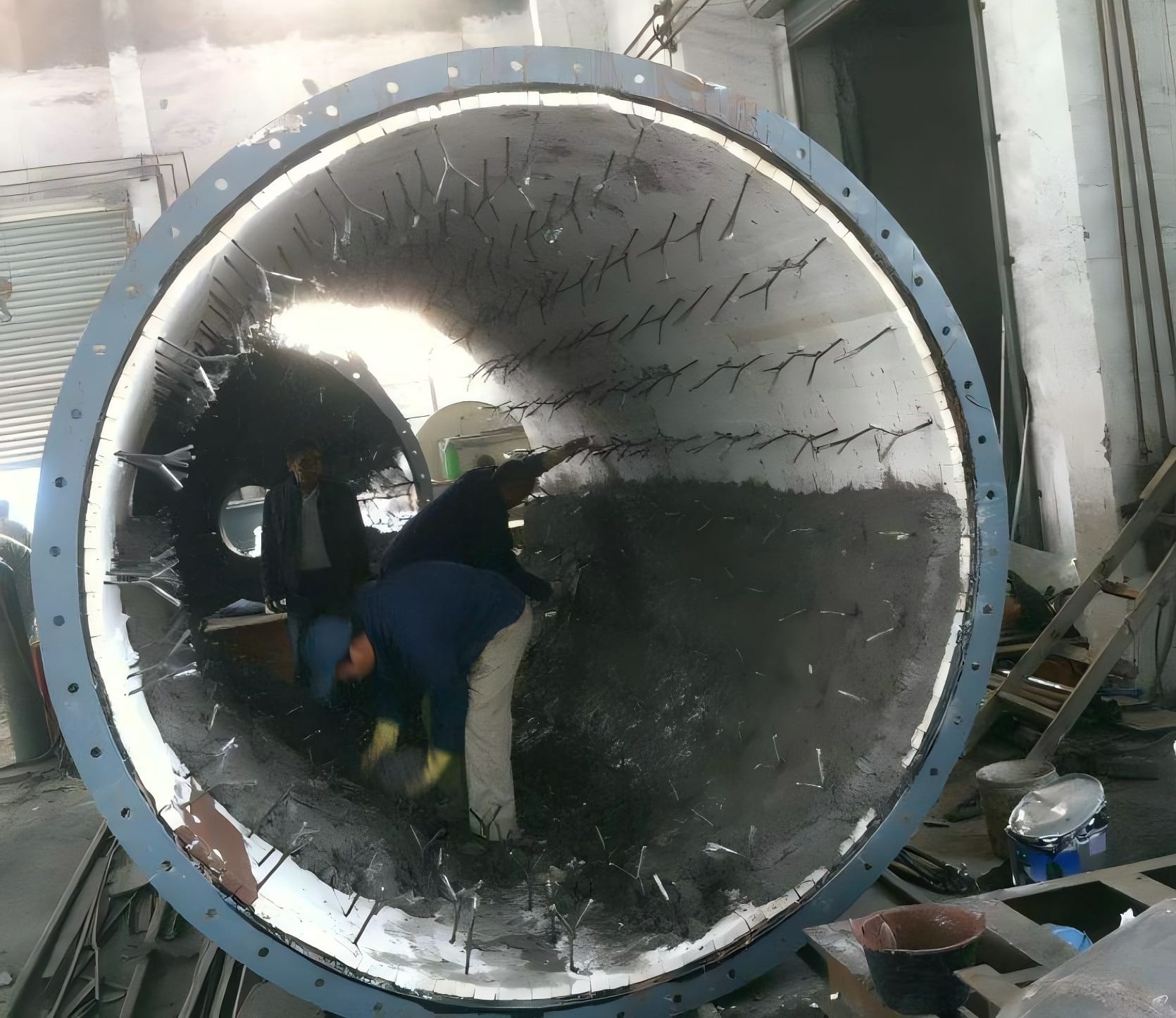
When the damaged area is large and the remaining bricks no longer have enough support, surface repair is not enough. In that case, castable material can fill the cavity and strengthen the lining.
Start by installing steel guide frames outside the damaged area. Insert steel rods through the kiln shell and into the refractory layer. They give temporary support and help prevent loose bricks, ash, and other debris from falling during cleaning.
Make small openings from the bottom of the damaged area, one after another. Remove loose bricks and debris until sound brickwork is exposed.
Install temporary steel formwork after cleaning. Then place the castable refractory through the prepared openings. Use vibration during placement to reduce voids and improve density.
After one section has enough support, remove the temporary steel rods and move to the next section. Repeat the same steps layer by layer until the whole damaged area is stable.
For large damaged sections, this staged method is very important. It helps prevent sudden collapse while keeping the lining above the repair zone supported.
The two methods fit different site conditions.
Use the external steel box method for local damage when fast repair and simpler work are the main goals.
Use the castable refractory injection method when damage is wide and the lining needs extra reinforcement.
In actual kiln maintenance, choose the repair method based on the damaged area, remaining brick condition, kiln structure, operating temperature, and available maintenance time.
A well-planned online repair can cut unplanned shutdowns, stop flame leakage, extend lining life, and delay a costly major overhaul.
If you are seeing hot spots, flame leakage, or signs of lining instability, contact Laurel Refractory to review your kiln conditions and choose the right castable refractory repair plan.
Related Products
Inquiry Now
Please leave your e-mail and we will contact you as soon as possible
+86-15264257623 Jacky Liu
1003, Building 1,The Fortune Zone, No.17 Lian yungang Road,Qingdao,China
For more details, welcome to message us.
Copyright © 2025 Qingdao laurent new materials co.,ltd.All Rights Reserved.
 Powered by HiCheng
contact us
Your satisfaction is our top priority. Whether you have questions, need support, or want to share feedback, our dedicated team is ready to assist you every step of the way.