Magnesia Brick and Magnesia-Based Refractory Products for High-Temperature Use
Magnesia brick is a basic refractory material produced from sintered magnesite with a purity greater than 87%. In magnesia brick, periclase serves as the main crystal phase, while secondary phases such as composite spinel, monticellite, forsterite, and a small amount of glass phase form the microstructure. Magnesia brick shows strong resistance to alkaline environments, while magnesia brick has weak resistance to acidic media. Substances such as B₂O₃ have a strong fluxing effect on magnesia brick. Even trace amounts of B₂O₃ in magnesia brick can reduce the creep resistance of magnesia brick at temperatures between 1200°C and 1250°C.
The bonding phase of magnesia brick mainly belongs to the CMS-M₂S system, which gives magnesia brick good thermal conductivity. As temperature increases, the thermal conductivity of magnesia brick decreases, while the heat capacity of magnesia brick increases. Magnesia brick has a high refractoriness, generally above 2000°C, but the load softening temperature of magnesia brick is around 1550°C. Magnesia brick also has relatively poor thermal shock resistance. The performance of magnesia brick depends on raw material properties, mineral composition, and microstructure, and it is closely related to the density of magnesia brick.
Magnesia-silica brick uses high-silica magnesite as the raw material, with SiO₂ content typically ranging from 5% to 11%. This composition influences the mineral phases and performance of magnesia brick in specific applications.
Raw Materials and Production Process
Manufacturers produce magnesia brick by crushing magnesia raw materials into coarse aggregates and fine powders. Workers proportion the materials according to specific formulations and add binders to mix them into a uniform batch. The mixture is then shaped, dried, and fired to form sintered magnesia brick. The firing temperature for ordinary magnesia brick ranges from 1500°C to 1650°C, while high-purity magnesia brick requires firing temperatures between 1700°C and 1900°C.
Chemically bonded magnesia brick follows a similar production route, but it uses chemical binders instead of high-temperature sintering. This type of magnesia brick does not require high firing temperatures and only needs appropriate low-temperature heat treatment to form unburned magnesia brick.
Magnesia brick has poor hydration resistance. When magnesia brick is exposed to water, hydration occurs easily, which leads to cracking and strength reduction. Therefore, manufacturers and users must protect magnesia brick from moisture, rain, and snow during storage and transportation.
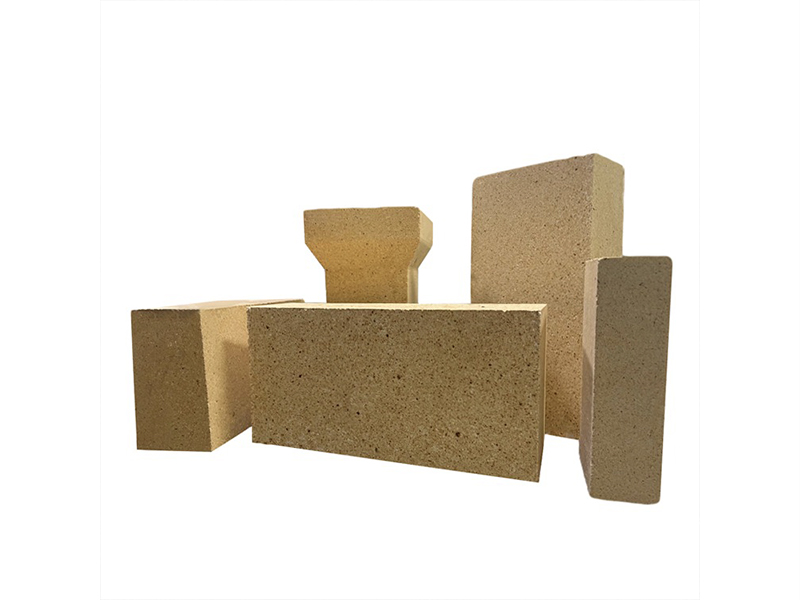
Magnesia-Chrome Brick
Magnesia-chrome brick is a basic refractory product containing 55%–80% MgO and 8%–20% Cr₂O₃. The main crystal phases in magnesia-chrome brick are periclase and composite spinel (XO·Y₂O₃). In this structure, XO mainly consists of MgO and FeO, while Y₂O₃ mainly consists of Cr₂O₃, Al₂O₃, and Fe₂O₃. The molar ratio of XO to Y₂O₃ is approximately equal, and excess Y₂O₃ dissolves into the composite spinel. Small amounts of silicate phases, such as forsterite and monticellite, are also present.
Magnesia-chrome brick is produced using high-quality sintered magnesia and chromite as the main raw materials. The chromite typically contains 30%–15% Cr₂O₃ and 1%–5% CaO. The production process of magnesia-chrome brick is similar to that of magnesia brick. Chemically bonded magnesia-chrome brick uses inorganic magnesium salt solutions as binders.
During firing, reactions between MgO and Cr₂O₃, Al₂O₃, or iron oxides form spinel phases, which can cause expansion and loosening effects. To avoid these issues, pre-synthesized magnesia-chrome clinker can be used. Firing must be carried out above 1600°C in an oxidizing atmosphere. If the atmosphere changes, Fe₂O₃ in chromite may undergo redox reactions, forming different iron oxides, while Cr₂O₃ may also be reduced to other valence states. These repeated reactions can damage magnesia-chrome brick, so products with higher MgO and lower Cr₂O₃ are generally preferred.
Types of Magnesia-Chrome Brick
Based on raw materials and production processes, magnesia-chrome brick can be classified into several types:
Fused Cast Magnesia-Chrome Brick
Fused cast magnesia-chrome brick is produced by electric melting and casting of magnesia and chromite. This type of magnesia-chrome brick has large but isolated pores, high density, high strength, and strong corrosion resistance. Fused cast magnesia-chrome brick is sensitive to temperature changes but offers good thermal stability and high load softening temperature.
Direct Bonded Magnesia-Chrome Brick
Direct bonded magnesia-chrome brick is made from sintered magnesia and chromite with low SiO₂ content. It is fired at temperatures above 1700°C to form direct bonding between periclase and chromite grains. Typical properties include MgO 82.61%, Cr₂O₃ 8.72%, SiO₂ 2.02%, apparent porosity 15%, bulk density 3.08 g/cm³, compressive strength 59.8 MPa, load softening temperature 1765°C, thermal shock resistance (1100°C water quenching) 14 cycles, and flexural strength 8.33 MPa.
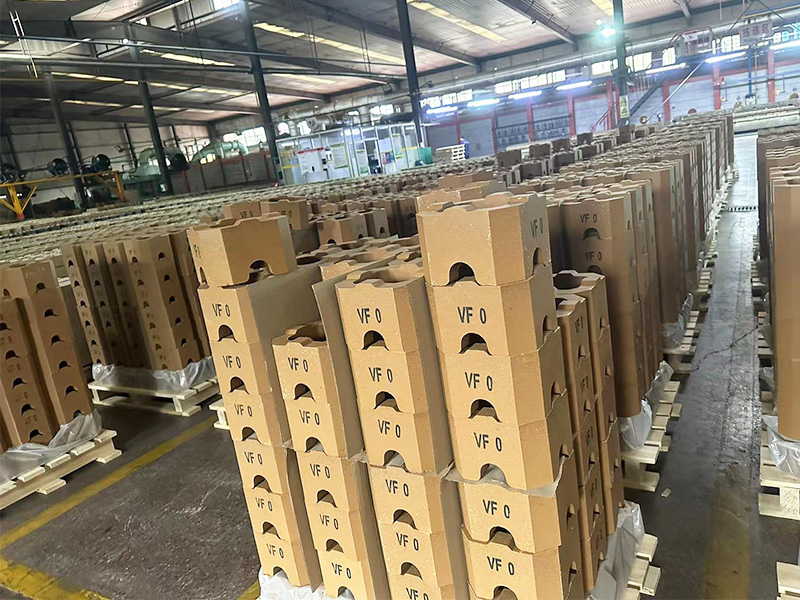
Silicate Bonded Magnesia-Chrome Brick
Silicate bonded magnesia-chrome brick is produced using sintered magnesia and chromite with appropriate proportions and fired at around 1600°C. The mineral composition includes periclase, spinel, and small amounts of silicates. Typical chemical composition includes SiO₂ 2.98%–4.50%, MgO 61.75%–72.69%, and Cr₂O₃ 10.04%–14.90%. Apparent porosity ranges from 18% to 21%, compressive strength from 36.1 to 50.0 MPa, and load softening temperature from 1600°C to 1640°C.
Rebonded and Semi-Rebonded Magnesia-Chrome Brick
Rebonded magnesia-chrome brick is produced from fused magnesia-chrome clinker through re-sintering. The structure contains evenly distributed pores and fine matrix phases with microcracks, which improve resistance to thermal shock compared to fused cast products. Semi-rebonded magnesia-chrome brick combines characteristics of rebonded and direct bonded types. Typical properties vary but generally show balanced strength and thermal performance.
Pre-Reacted Magnesia-Chrome Brick
Pre-reacted magnesia-chrome brick uses fully or partially pre-reacted magnesia-chrome clinker. Partial reactions between magnesia and chromite occur during calcination, which reduces porosity and improves high-temperature strength. This type offers lower production cost compared to rebonded products.
Chemically Bonded (Unburned) Magnesia-Chrome Brick
Unburned magnesia-chrome brick is produced by mixing sintered magnesia and chromite with chemical binders and curing at low temperatures. Some products harden at room temperature, while others require moderate heating. During high-temperature service, ceramic bonding phases form, improving performance. Typical properties include MgO 52.73%, Cr₂O₃ 18.08%, SiO₂ 5.0%, apparent porosity 10.9%, compressive strength 58 MPa, and load softening temperature of 1520–1530°C.
Related Products
Inquiry Now
Please leave your e-mail and we will contact you as soon as possible
+86-15264257623 Jacky Liu
1003, Building 1,The Fortune Zone, No.17 Lian yungang Road,Qingdao,China
For more details, welcome to message us.
Copyright © 2025 Qingdao laurent new materials co.,ltd.All Rights Reserved.
 Powered by HiCheng
contact us
Your satisfaction is our top priority. Whether you have questions, need support, or want to share feedback, our dedicated team is ready to assist you every step of the way.